
The Essential Guide to Food Safety Culture
Food safety culture is about how people across an organization think about and approach food safety—and, ultimately, how those attitudes show up in their day-to-day decisions.
It goes beyond having the right procedures in place. A facility can have a strong HACCP plan, detailed work instructions, and a well-maintained food safety management system, but those things only work when people understand them, believe they matter, and consistently put them into practice.
That’s why food safety culture has become such an important part of food safety management and GFSI certification.
This guide explains what food safety culture means, why it matters, what major GFSI-benchmarked certification standards expect, and how food safety professionals can assess, improve, and measure culture at their facilities.
What is food safety culture?
The Global Food Safety Initiative (GFSI) defines food safety culture as the shared values, beliefs, and norms that affect the way people think about and behave toward food safety throughout an organization.
Put more simply, food safety culture influences the decisions people make when they encounter a situation that isn’t covered perfectly by a procedure.
You can see culture in everyday situations:
- How a new employee is introduced to food safety expectations
- Whether a supervisor takes a production concern seriously
- Whether employees feel comfortable reporting a mistake or near-miss
- How management responds when food safety requirements conflict with production pressures
- Whether employees understand why a requirement matters, rather than simply knowing that they’re supposed to follow it
These individual decisions add up. Over time, they tell you a lot about the food safety culture of an organization.
Food safety culture is:
- The behaviors and expectations that people consistently demonstrate
- A combination of leadership and employee behavior
- An understanding of food safety risks and why controls matter
- An ongoing effort to improve how people work
Food Safety Culture isn’t:
- A poster campaign
- An annual employee survey that gets filed away
- Something that belongs only to QA or the food safety team
- A replacement for a food safety management system
- Something you prepare just before an audit
Why does it matter?
A food safety management system provides the structure for managing food safety. Culture influences how well that system works in practice.
A simple way to think about the relationship is:
FSMS → Culture → Behavior → Outcomes
Consider a HACCP plan. The plan itself doesn’t prevent contamination. The people responsible for monitoring, responding to deviations, cleaning equipment, handling product, and following procedures are what make those controls effective.
The food safety management system defines what should happen. Food safety culture influences whether and how it happens in practice.
And those decisions don’t always happen under ideal circumstances. Employees may be working under time pressure. A supervisor may be dealing with a staffing shortage. Production may be behind schedule. Someone may notice a problem when no manager is nearby.
A strong food safety culture helps people make the right decision even in those situations.
Food safety culture vs. your food safety management system
Food safety culture and your food safety management system are closely connected, but they’re not the same thing.
Your food safety management system (FSMS) is the formal system. It includes your policies, procedures, HACCP plan, prerequisite programs, GMPs, monitoring records, corrective actions, and other documented controls.
Food safety culture is how people interact with that system. It reflects whether employees understand the expectations, whether leadership reinforces them, and whether people actually follow them when circumstances get difficult.
The food safety management system defines what should happen. Food safety culture influences whether and how it happens in practice.
It’s possible to have a technically strong FSMS and still have a weak food safety culture. Procedures may be followed only when someone is watching. Employees may hesitate to report problems. Production pressures may consistently take priority over food safety.
The opposite can happen, too. Employees may genuinely care about food safety, but a confusing or poorly designed system can make it difficult for them to do the right thing.
Effective food safety management requires both.
The GFSI food safety culture framework
GFSI provides a framework for understanding the elements that contribute to food safety culture. It establishes the general expectations while allowing certification standard owners and individual organizations to determine how those expectations are put into practice.
The original five dimensions
The 2018 GFSI framework identified five dimensions of food safety culture:
- Vision & Mission — leadership direction and purpose
- People — governance, communication, motivation, and recognition
- Consistency — accountability, performance measurement, and documentation
- Adaptability — change management, agility, and problem-solving
- Hazard & Risk Awareness — employee education, engagement, and understanding of food safety risks
These five dimensions remain useful for understanding food safety culture and are still commonly referenced by food safety professionals and auditors.
GFSI Version 2.0 (2026)
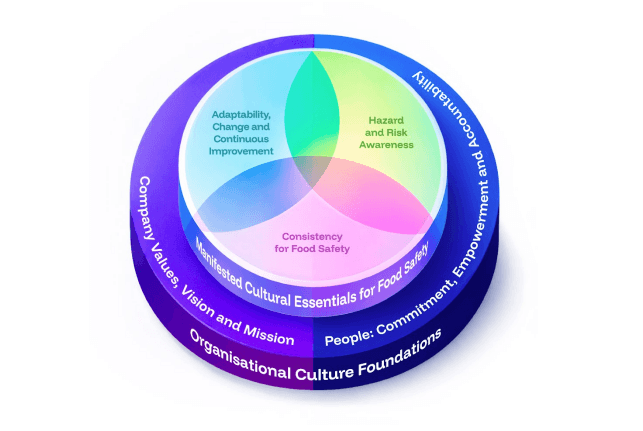
In 2026, GFSI introduced A Culture of Food Safety, Version 2.0. The updated framework builds on the concepts in the original framework but organizes them differently.
Version 2.0 uses two broad areas:
- Organizational Culture Foundations — values, vision, mission, and people, including commitment, empowerment, and accountability
- Manifested Cultural Essentials — hazard and risk awareness, consistency, and adaptability/continuous improvement
The updated framework doesn’t make the original five dimensions irrelevant. Instead, it provides a new way of organizing and thinking about many of the same underlying elements.
For organizations already using the original framework, this makes it possible to build on what they have rather than starting from scratch.
Requirements from GFSI benchmarked platforms:
Food safety culture is now an explicit part of several GFSI-benchmarked certification standards. While the underlying concepts are similar, the requirements are not identical.
If your facility is certified—or preparing for certification—it’s important to understand the specific requirements that apply to your organization.
BRCGS Food Safety Culture Requirements
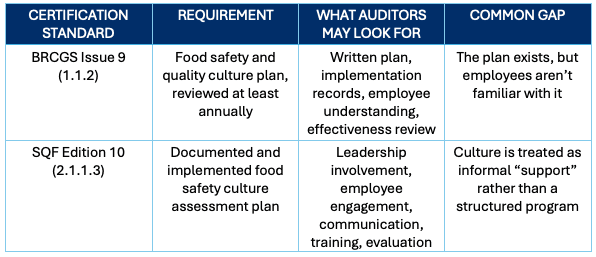
Under BRCGS Food Safety Issue 9, Clause 1.1.2, senior management is responsible for establishing and maintaining a clear plan for developing and continually improving food safety and quality culture.
The plan should include activities that address the different parts of the site that can affect product safety, along with an action plan, timelines, review of effectiveness, and an annual review and update.
Auditors will want to see evidence that the plan is actually being implemented. That can include documentation, employee interviews, training and communication records, and evidence that activities are being reviewed for effectiveness.
Common gaps include having a plan that employees aren’t familiar with, relying on activities that are difficult to measure, or treating food safety culture as a QA-only initiative.
SQF Food Safety Culture Requirements
SQF Edition 10 includes a documented food safety culture assessment plan as a Core Clause under 2.1.1.3.
The important point is that SQF’s requirement goes beyond simply demonstrating that leadership supports food safety. Sites are expected to have a documented, implemented, and maintained approach to assessing and improving food safety culture.
Auditors may look for evidence of leadership involvement, employee engagement, communication, training, feedback, and evaluation.
One common mistake is treating food safety culture as an informal leadership initiative rather than as a structured part of the site’s food safety management system.
How do you assess culture?
It takes a lot more than an employee survey.
Different methods reveal different parts of the picture. Surveys can tell you how employees perceive food safety. Interviews can reveal whether people understand expectations. Observations show what actually happens on the floor. Performance data can help determine whether those behaviors are affecting results.
A well-rounded assessment may include:
- Surveys — useful for identifying perceptions and trends, but not enough on their own
- Interviews — a chance to understand what employees actually know and believe
- Observation — seeing how food safety practices are carried out in real situations
- KPIs and performance data — looking for measurable trends
- Audit findings — identifying recurring issues and patterns
- Employee feedback — including both formal feedback and informal conversations
- Gap analysis — comparing your current program with the requirements that apply to your site
How do you build a food safety culture plan?
A food safety culture plan doesn’t need to be complicated. It does need to be specific enough that people know what they’re trying to change, who is responsible, and how they’ll know whether it worked.
A practical approach includes:
- Assessing your current culture
- Identifying gaps and priorities
- Setting clear objectives
- Defining specific activities
- Assigning responsibility
- Establishing measures
- Evaluating whether the activities were effective
- Reviewing and updating the plan at least annually
The key is to connect activities to actual culture gaps. If employees don’t understand a particular food safety risk, training may be appropriate. If employees understand the risk but don’t feel comfortable reporting problems, communication and leadership behaviors may be more important.
What is a food safety culture maturity model?
A maturity model gives an organization a way to think about where its food safety culture is today and what improvement could look like over time.
It isn’t necessarily a scorecard or a way to compare one facility against another. Instead, it can help organizations identify their current state and determine what to focus on next.
Several published models exist, including Jespersen’s five-stage model and Manning’s seven-stage model. While the terminology varies, many maturity models describe a similar progression:
Reactive → Aware → Defined → Integrated → Continuously Improving
The value of a maturity model is less about reaching a particular label and more about having a consistent way to discuss progress.
Need help improving your food safety culture?
Whether you’re preparing for certification, responding to an audit finding, or simply trying to strengthen your food safety program, the right starting point depends on where your organization is today.
Preparing for certification?
Our Food Safety Culture Gap Assessment can help you understand where your program stands and identify areas to address before your audit.
Received an Audit finding?
Our Training and Consulting team can help you develop a practical plan that your team can implement and maintain.
Need to build your teams knowledge?
Food Safety Culture Training can help your team understand the fundamentals and put them into practice, with options for onsite training or scheduled courses.